
AI Is Helping Creative Teams Move Faster. But Are We Measuring What Matters?
AI is quickly becoming part of the everyday creative process, and we’re seeing that show up in obvious ways for in-house teams: faster drafts, more variations, smoother handoffs, and less time spent on repetitive work.
But speed alone is not the answer.
For us, the real opportunity is using AI to help teams work with more clarity, focus, and consistency. When communication is shared, strategy is well defined, and handoffs are clear, teams can move faster and work more efficiently without sacrificing quality.
That foundation really matters. Yes, AI can help accelerate the process, but it doesn’t make up for a poorly written brief, poor feedback, or an unclear strategy. Without those foundational pieces in place, more output quickly becomes more confusion and more rework.
So for in-house creative leaders, the question is not just, “Are we moving faster?” It’s also, “Are we creating better, more impactful work?”
Measuring Success
To understand the real impact AI is having on in-house creative teams, we need to measure both sides of the work: how efficiently we are moving and how impactful the creative is when it gets out the door.
It cannot just be about producing more. It has to be about producing better work with less friction.
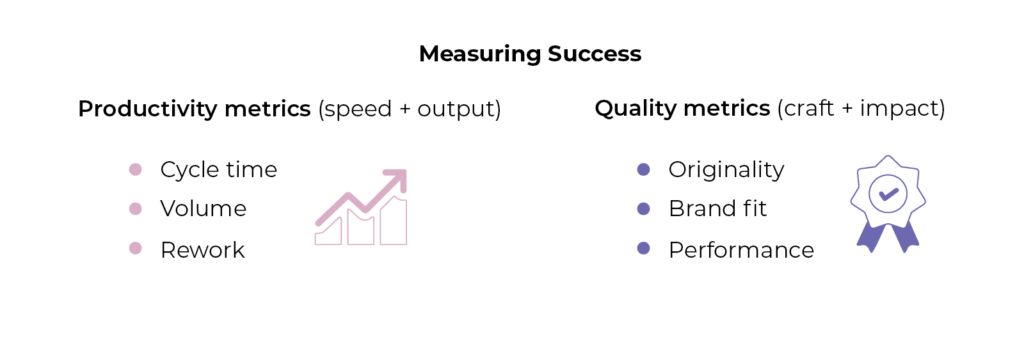
The productivity side helps us understand whether AI is improving the way the team works. Are we reducing production time? Are we creating more valuable assets? Are we cutting down on unnecessary rounds of revision?
The quality side helps us understand whether the work is doing what it needs to do. Does it feel original? Does it fit the brand? Is it performing with the audience?
Both matter. If we only measure speed, we risk turning creative into a volume exercise. And measuring quality helps us understand whether the work is original, on brand, and driving the right impact.
Additionally, measuring AI’s impact becomes difficult when ownership is unclear. Teams may be using AI every day, but leaders often lack visibility into where it is being used, who is using it, or whether it is actually improving the work..
Creative leaders need more than a general sense that AI is helping. They need a simple, repeatable measurement approach that defines who owns the metrics, what is being tracked, and how those insights are used to refine workflows, improve output, and make better decisions over time.
What AI Can Actually Improve
For in-house creative and marketing teams, AI can be really useful in the parts of the process where work tends to get stuck. It can help with early exploration, first-pass copy, campaign variations, feedback summaries, versioning, and asset adaptation.
That support gives the team more room to focus on the work that requires real creative judgment: shaping the idea, protecting the brand, understanding the audience, and making sure the final output hits the mark.
But AI works best when its role is clear. It should support the team, not blur ownership or replace critical decision-making. The team still needs to understand the problem, define what good looks like, and know who is responsible for moving the work forward.
The Metrics
If we want to measure AI’s impact on an in-house team, we’d start with a few practical signals.
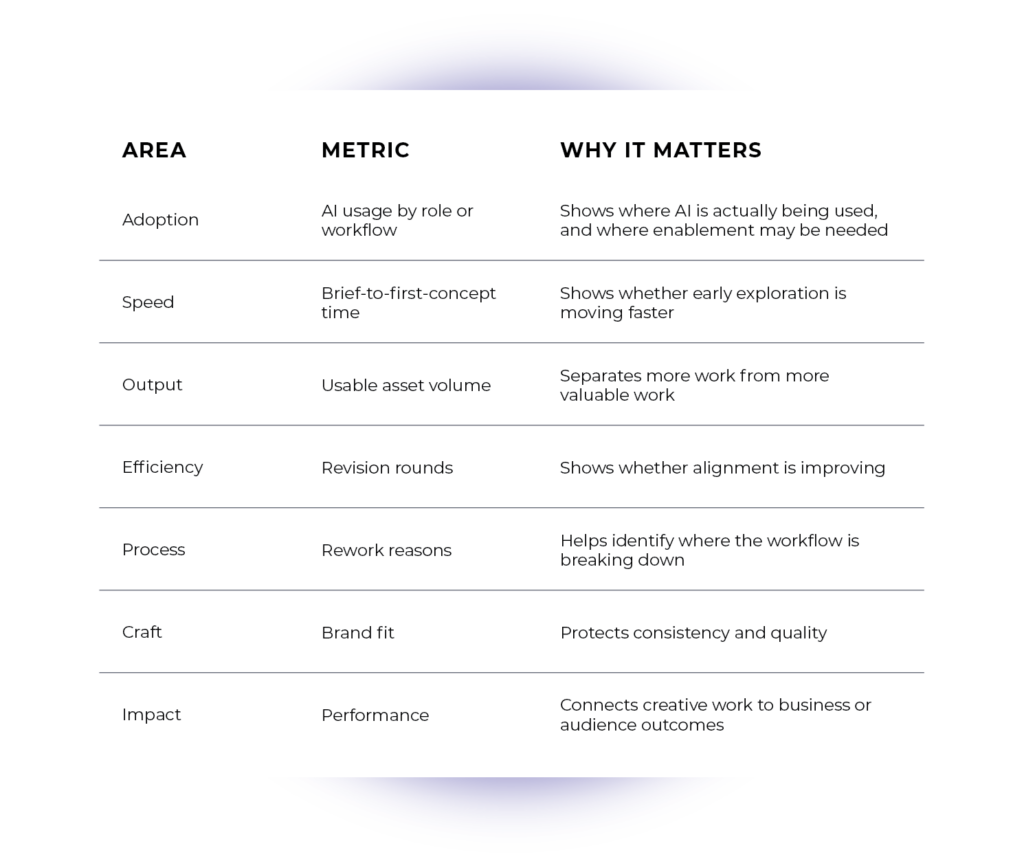
This gives leaders a clearer view of whether AI is simply making the team faster, or actually helping the team produce stronger, more consistent work.
These metrics can help create a more balanced view of progress. They show whether AI is helping us move faster, and whether that speed is leading to stronger work.
A shorter cycle time only matters if the work still meets the brief. More variations are only useful if they are on brand and connected to the strategy. Fewer revision rounds matter when they point to better alignment, not just faster approvals.
The best way to measure AI is to start small. Rather than trying to assess the entire creative process at once, choose one repeatable task, such as first-pass social copy, campaign concept exploration, resizing assets, summarizing feedback, or adapting a campaign for multiple channels.
Then compare the AI-assisted version against the current process. Track how long the task takes, how many revision rounds are needed, and whether the final work meets the same quality bar. Where possible, have reviewers evaluate the work without knowing whether AI was used.
Judgement Matters
The more AI becomes part of the workflow, the more important the human role becomes. Creative teams bring taste, judgment, context, empathy, and brand understanding to the process.
Yes, AI can give us options, but it cannot always tell us which option is right. It can help us move faster, but it cannot decide what the brand should stand for. It can create a starting point, but the team still has to shape the idea into something that resonates with the audience.
In-house teams are especially well positioned for this because they are close to the brand, the business, and the audience. That closeness is an advantage. AI can help create capacity, but the team’s understanding of the brand and its audience is what gives the work meaning and relevance.
The Bottom Line
AI can make in-house creative teams faster. That part is already happening. But for me, the bigger opportunity is using AI to make the work more impactful.
That’s the real measure of success: not just more output or shorter timelines, but better work with less friction. Work that moves through the system more smoothly, stays true to the brand, and creates a stronger cultural impact once it reaches the audience.
We touch on many of these ideas in our AI Creative Impact Report. If you are leading, working within, or starting to build an in-house creative or marketing team, this report is for you.
You can download it here.