
The Real AI Challenge for Creative Teams Isn’t Adoption. It’s Alignment.
Our 2026 AI Creative Impact Report explores where leaders and talent are aligned, where the gaps are growing, and what creative teams need next.
AI is no longer a future-state conversation for creative and marketing teams. It’s already here, already influencing workflows, and already changing expectations.
But after talking with leaders and talent across the creative ecosystem, one thing is clear: the biggest challenge isn’t whether teams are using AI. It’s whether the people setting the direction and the people doing the work are aligned on how it should be used.
That’s why we created the 2026 AI Creative Impact Report.
We wanted to get beyond the usual AI hype and get a clearer view of what’s actually happening inside creative and marketing teams right now. Where is AI creating momentum? Where is it creating tension? And what do leaders and talent need from each other to make this next chapter of creative work more effective, more sustainable, and more human?
To answer that, we combined survey data with live conversations across both sides of the work experience. At the close of 2025, we surveyed creative and marketing leaders and talent, then added moderated focus groups to capture the nuance behind the numbers. The result is not a tool review or a generic playbook. It’s a grounded look at where teams are today, where alignment is starting to break down, and what it will take to move forward with more clarity.
This report is for:
- Creative and marketing leaders trying to introduce AI without eroding quality or trust
- Teams that know AI matters, but want a smarter way to bring it into real workflows
A few things stood out immediately.
First, the optimism is real. Nearly 68% of talent said AI’s impact on their work has been positive, and 77% of leaders described their team’s attitude toward AI as optimistic. This is not a story of blanket resistance. It’s a story of real momentum.
But momentum and readiness are not the same thing.
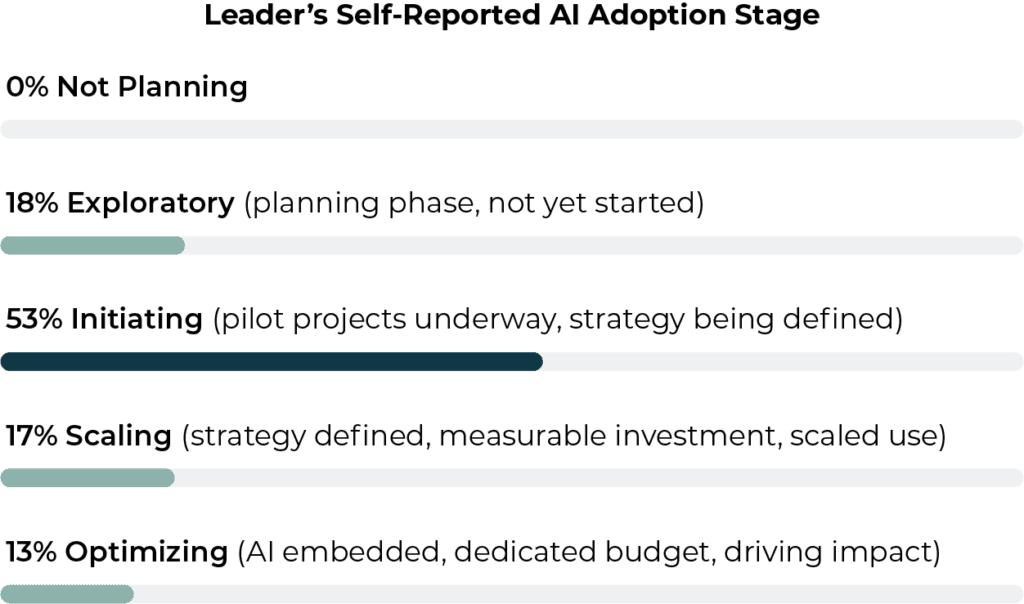
Many organizations are still early in adoption, with leaders reporting that much of the work is still in pilot mode while strategy catches up. At the same time, talent is already experimenting in daily workflows, often before clear standards or guardrails are in place. That gap between use and structure is one of the defining tensions in the report.
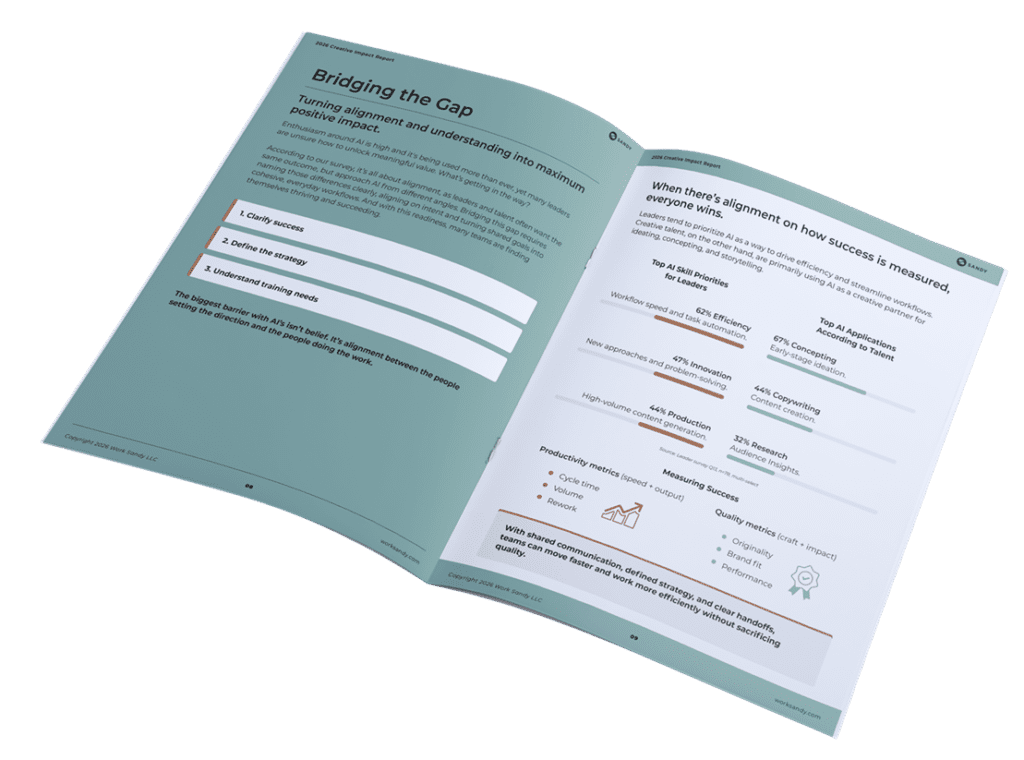
We also found that leaders and talent are often aiming for the same outcome, but approaching AI from different angles. Leaders are more likely to prioritize efficiency, workflow speed, and automation. Talent is more likely to use AI as a creative partner for concepting, copy, and research. Neither side is wrong, but the disconnect matters. When success is measured differently, adoption gets messy.
And beneath all of this optimism, concern is still very present.
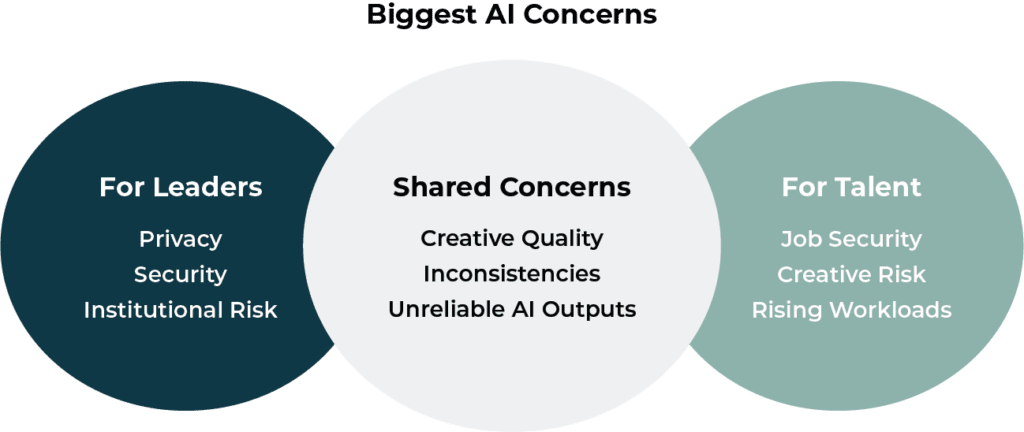
The report found that talent is more likely to view AI as a threat to job security and a contributor to rising workloads, while leadership is more worried about privacy, security, and institutional risk. In other words, both groups are concerned, but not always about the same things. That difference helps explain why so many teams feel like they’re moving fast, but not always in the same direction.
There is good news, though: the path forward is becoming clearer.
The strongest signal in the data is that teams do not need more noise. They need more intention. They need shared definitions of success, better guardrails, role-specific training, and clearer expectations around where AI helps and where human judgment still matters most. The organizations making the most meaningful progress are not simply buying tools. They’re building alignment.
That’s the conversation we hope this report helps move forward.
If you’re leading a team through AI adoption, trying to protect craft while increasing speed, or simply trying to understand how creative work is changing in practice, this report was built for you.
Read the full 2026 AI Creative Impact Report and explore the findings shaping the next era of creative work.